When shared mailbox sent items not saving becomes the blocker, do not start by rebuilding the whole setup. Shared mailbox sent items may save in the sender mailbox, the shared mailbox, or neither visible folder depending on delegate setup and how the mailbox was added. The fastest fix is to prove which layer is failing: the source item, the signed-in account, the local client, or the server-side permission behind the feature.
Start with the same account the user actually uses for daily work. Many Microsoft 365 issues look random when Outlook, Word, PowerPoint, SharePoint, or Power Automate is signed in with more than one tenant or mailbox. If the feature works in the browser but not in the desktop app, focus on cache, add-ins, or the local session rather than changing organization settings.
Confirm the expected behavior first
Before changing settings, document what should happen. Identify the mailbox, file, flow, calendar, or meeting item where the issue appears, then compare it with one similar item that works. This keeps the troubleshooting focused and prevents a broad reset that hides the real cause.
- Confirm the affected user, mailbox, document, flow, or SharePoint library.
- Reproduce the issue once in the current app session.
- Check whether another eligible item works with the same account.
- Try the web version of the app before changing admin settings.
- Note any recent permission, license, sharing, or mailbox changes.
If the problem affects only one object, treat it as an item-level access or configuration issue. If it affects every object for the user, check licensing, account state, policy, and the local client. If it affects several users at once, escalate to an administrator with the exact object name and time of the failed test.
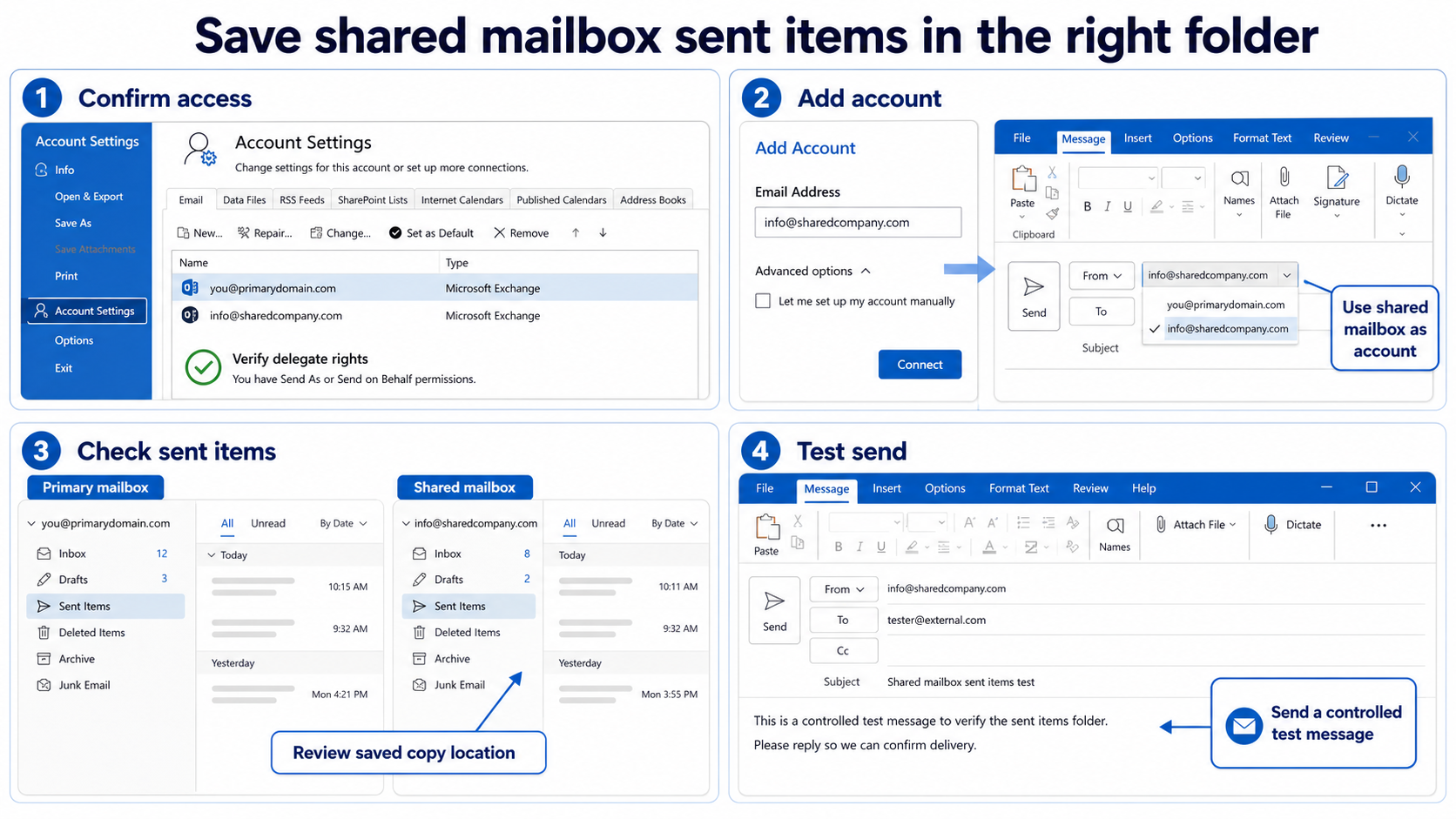
The four checks to run
- Confirm delegate access: Use the exact item where the failure occurs and avoid testing with a different mailbox, file, or calendar by mistake.
- Add the mailbox as an account: Confirm that the user has the right access level and that the feature is available for that account.
- Check both Sent folders: Close the current window, reopen the app, and clear the simplest stale state before changing the underlying configuration.
- Send a controlled test: Use the browser version as a clean comparison because it bypasses many local desktop cache and add-in problems.
Fix the most common cause
For most readers, the practical fix is not one dramatic reset. It is a careful sequence: confirm the account, refresh the item, retry the feature, and only then adjust permissions or policy. Keep the original item open in one window and the settings or web comparison in another so you can verify each change immediately.
If the issue is in Outlook, check the selected mailbox and whether the feature is being tested in new Outlook, classic Outlook, and Outlook on the web. Shared mailboxes, shared calendars, room lists, rules, and Copilot prompts can behave differently when the wrong mailbox is selected. Reopen the item from the mailbox that owns it instead of using a cached shortcut. If the symptom follows mailbox or calendar state, a practical next step helps compare the related Outlook setting before you rebuild the profile.
If the issue is in Word or PowerPoint, save the file first and confirm that the document is editable. Copilot and recording features usually need a stable document session, not a recovered or read-only file. If the file came from SharePoint or OneDrive, reopen it from the browser to confirm that permissions and sync state are not blocking the feature.
If the issue is in Power Automate or AI Builder, check the environment before editing the flow. A model, approval action, or connector can exist in one environment and be unavailable in another. Review the latest run history and use a controlled test so you can see whether the problem is design-time visibility or run-time delivery.
Check permissions and client state
Permissions are the second place to look. A user can often see an item while still lacking the specific right needed to draft, summarize, save, approve, download, or edit it. Ask the owner to confirm the permission level instead of assuming visibility equals full access.
Client state is the third place to look. Cached calendar entries, old Office sessions, disabled add-ins, stale shared mailbox connections, and paused sync clients can all preserve an old view after the server-side setting was corrected. Restarting the app is useful, but a browser comparison is more useful because it tells you whether the change reached Microsoft 365.
What to capture before escalation
- The exact account and mailbox or workspace used in the failed test.
- Whether the same action works in the web version.
- The permission level shown by the owner or administrator.
- Any recent licensing, sharing, environment, or policy change.
- A screenshot of the affected pane without private message or file content.
Give the administrator the exact keyword-level symptom: “shared mailbox sent items not saving”. That wording is clearer than saying the app is broken, and it points them toward account context, permissions, and feature availability.
Useful answers
Why does this work in the browser but not the desktop app?
The browser uses a fresh Microsoft 365 session and avoids many local add-ins, cached panes, and old desktop tokens. When the browser works, keep the server-side setting in place and focus on the local app session, account picker, or cached item.
Should I remove and recreate the mailbox, file, flow, or calendar?
Only do that after you have confirmed the object is misconfigured. Recreating the item too early can remove useful evidence and may create duplicate calendars, rules, approvals, or files that confuse other users.
When should an administrator get involved?
Escalate when the web app fails for the same account, when multiple users are affected, or when the owner cannot confirm the needed permission. Include the exact object, user, time of test, and whether the problem reproduced in the browser.
Should I test this in Outlook on the web?
Yes. The web app is a useful control because it removes part of the local desktop app from the test. If the same account works on the web but not in the desktop app, focus on cache, updates, add-ins, or the local profile before changing tenant-wide settings.
What if the same setup works for another user?
That usually points to an account, license, permission, or profile difference rather than a broken feature for everyone. Compare the affected user’s role, mailbox or file access, app license, and client version before rebuilding the workflow.
When should I ask an administrator to check this?
Escalate when several users see the same symptom, when the setting is controlled by policy, or when the fix requires access you do not have. Give the administrator the affected account, client, time of the test, and the exact result from the web or desktop comparison.
What to do next?
The clean path is to test the affected item, confirm the correct account, compare the web app, and then adjust permissions or client state based on that result. That sequence keeps the fix narrow and avoids broad resets that make Microsoft 365 troubleshooting harder to verify. If this points to access rather than the visible setting, the companion troubleshooting path is a useful comparison before you change more permissions.