A private Outlook meeting does not disappear from a shared calendar. Most viewers can still see that time is occupied, while the subject, location, and other details are hidden. A lock icon tells the calendar owner that the item is marked Private; what a delegate sees depends on the permission granted to that delegate.
What the calendar blocks actually reveal
For a normal shared-calendar viewer, the event generally appears as a private block rather than a readable appointment. Microsoft states that people with calendar access usually see only the time of a private item. A delegate is the important exception when the owner explicitly enables permission to view private events.
Before changing anything, review the permission-level comparison so you do not confuse Can edit with Delegate access. Delegates can act on behalf of the owner; editors can change calendar items but do not receive the same meeting-request workflow.
After each change, repeat the smallest test that originally failed. A successful result in a different client narrows the fault but does not automatically repair the original one. Record the boundary, apply the targeted correction, and test again in the user’s normal workflow.
Mark an event private in the right client
New Outlook and the web
Open an event you organized, choose Private on the Event tab or toolbar, and save or send the update. The owner sees a lock on the item.
Classic Outlook
Open or select the appointment, use Private in the Tags group, and choose Save & Close. For a meeting, send the update when Outlook asks so attendees receive the revised item.
Marking an item private after delegates already read it cannot retract information they remember or copied. Apply the setting before sharing sensitive details.
A useful test changes one variable at a time. Keep the same account and content while switching only the client, then keep the client and switch only the account or item. This produces evidence you can act on instead of a pile of unrelated resets.
Review the delegate exception
Open the calendar sharing or delegate settings and find each person with access. In new Outlook, the relevant delegate option is Let delegate view private events. In classic Outlook, it is Delegate can see my private items. Clear that permission for anyone who should only see the occupied time.
The setting can affect more than one private item, so do not toggle it casually for a single appointment. If your team is redesigning access, your broader sharing setup provides the context for busy-only, titles-and-locations, and full-details sharing.
Avoid destructive cleanup until you know whether the authoritative copy is in the cloud, mailbox, calendar, or local profile. Export or verify important data first. In managed environments, a policy result should be handed to the administrator with exact timestamps and reproduction steps rather than worked around.
Test with a harmless sample
Create a private appointment with an unmistakable but non-sensitive subject, invite no one, and ask the delegate what appears. Test in the client the delegate actually uses because cached views can lag. If full details remain visible, recheck the private-items permission, confirm the delegate is viewing the correct calendar, and allow time for the permission change to propagate.
After each change, repeat the smallest test that originally failed. A successful result in a different client narrows the fault but does not automatically repair the original one. Record the boundary, apply the targeted correction, and test again in the user’s normal workflow.
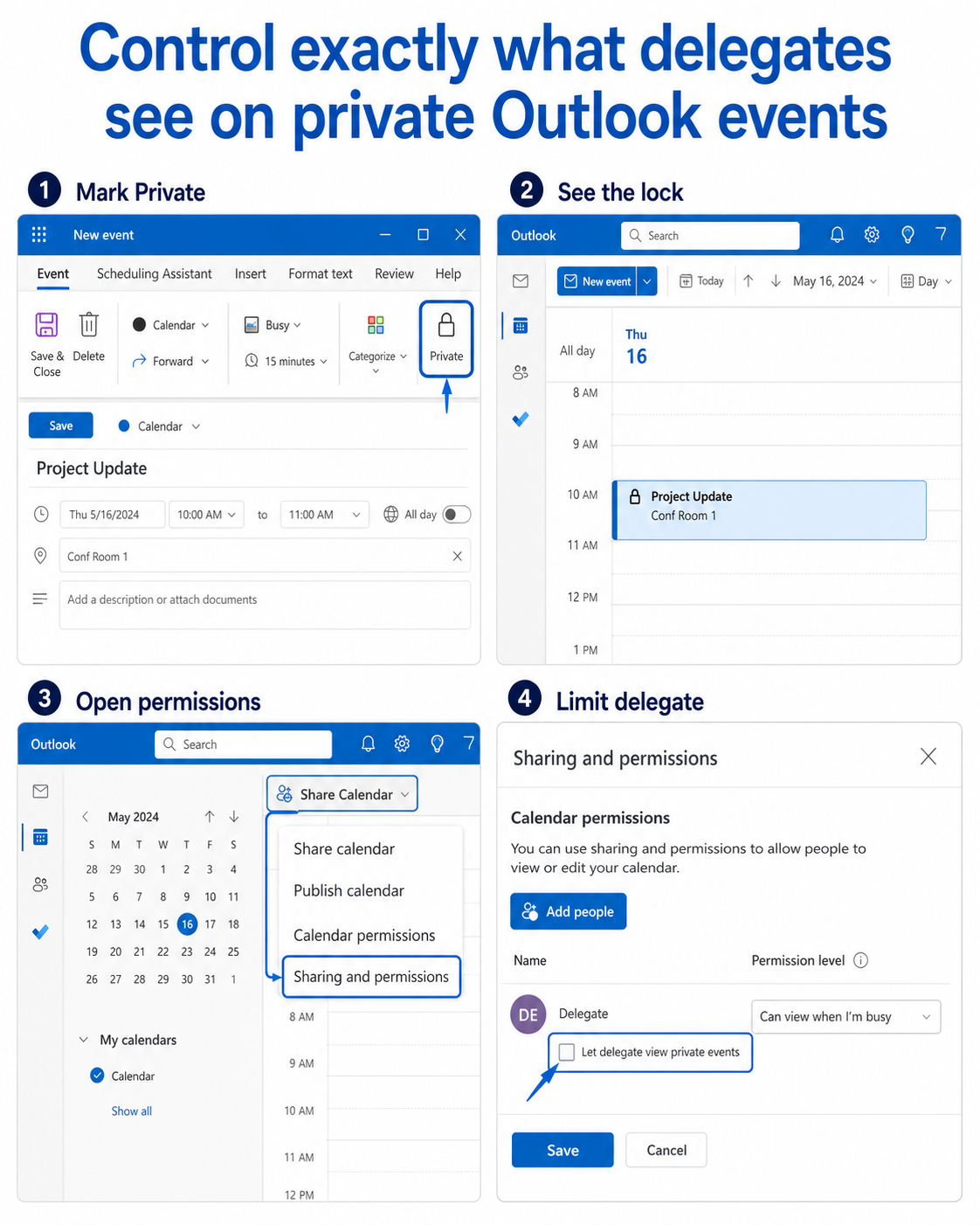
A permission review that does not expose real details
Use a harmless calendar item for the final comparison, not the user’s confidential production content. Note the signed-in account, client, approximate time, and exact visible result. Then repeat the same action once from a second supported client. A difference between clients points toward local state or a client-specific experience; the same result everywhere points toward the account, source data, policy, or service.
Keep the test matrix small enough to explain. One row can represent the normal user and original item, a second the same user with a clean test item, and a third an approved comparison account when available. Change only one condition between rows. This discipline matters because simultaneous sign-outs, cache clearing, permission changes, and item recreation can hide the cause and make the next incident harder to diagnose.
Check the owner boundary before applying the result. End users can usually refresh a client, choose a supported item, or correct their own setting. Owners control sharing and source data. Administrators control tenant policy, effective assignments, managed browser rules, licensing, and service-health escalation. Stop at that boundary and provide evidence instead of asking the user to bypass a security decision.
Finally, return to the ordinary workflow and repeat the exact action that failed. Confirm both the immediate screen and the downstream result: the other attendee’s view, the saved calendar item, the mailbox copy, the flow run, the synced browser data, or the participant’s lobby entry. A button appearing is only partial recovery when the expected output is still missing.
Private-calendar answers
Can attendees still see a private meeting title?
Yes. Private hides details from people who merely view your shared calendar; it does not hide the meeting from invited attendees. Attendees need the subject, time, and joining information to participate.
Does Private make an Outlook appointment secure?
No. Microsoft cautions that Private should not be treated as a security boundary. Limit calendar permissions, avoid sensitive text in the title, and use your organization’s approved system for confidential records.
Why can one delegate read the details while another cannot?
Private-item access is granted per delegate. Compare the two delegate records and look specifically for permission to view private events rather than assuming their general calendar role is identical.
Use privacy as one layer
The best result is a repeatable test that identifies the responsible layer and leaves the user’s data and security controls intact. Keep the successful change, undo speculative ones, and share the narrow evidence with the owner of any policy or service dependency. Retest in the normal client before treating the incident as resolved. If the symptom returns, compare it with the recorded boundary before repeating cleanup; recurrence after the same trigger is far more useful than a vague report that the app failed again.